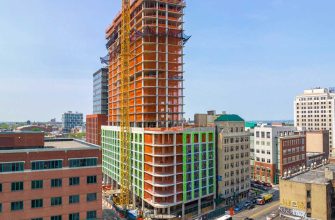
Hartz Mountain Industries and Roseland Property Company have announced plan to build a 1,000-unit apartment building in Jersey City’s Colgate Center — if the state revives a tax credit program for developers.

With a price tag of $450 million and a total size of more than one million square feet, the development at 99 Hudson Street would create more than 2,000 long-term construction jobs over a five year period, according to Hartz.
It would also be the largest rental project and one of the top five tallest buildings in New Jersey.
Emanuel Stern, president and COO of Hartz Mountain Industries, said the project will only be developed subject to revival of the NJ Economic Development Agency’s Urban Hub Tax Credit (UHTC) residential program, which was suspended after depleting its $250 million allocation.
“We submitted an application several months ago that fully qualified for the UHTC program,” said Stern. “As we have seen through the history of the UHTC program, the economic climate — especially as it pertains to financing – will not permit a project like this to proceed without assistance.
“Our application to EDA for the UHTC program delivers instant economic impact and smart growth benefits that will last for decades, so we are hopeful this necessary program is quickly revived so we can commence construction.”
Colgate Center is home to 90 and 70 Hudson Street, which were developed by Hartz Mountain and when sold last year were named the most expensive office buildings in New Jersey.
After Hartz’s speculative construction of 70 and 90 in the late 1990s, Goldman Sachs built its tower and a Hovnanian-developed luxury condominium at 77 Hudson.
Roseland Property Company, which manages Hartz Mountain’s residential projects and is a partner in four of Hartz’s residential developments, envisions support retail and entertainment on the structure, which provided parking for residents and guests.
“The waterfront in Jersey City features many compelling pieces, but it lacks a center,” said Carl Goldberg, partner in Roseland Property Company.
“We see 99 Hudson providing the components that would turn an interesting area into a classic neighborhood.”
Jersey City Mayor Jerremiah Healy told the local Jersey Journal he was fully behind the plan. “This is another example of the continued investment and development in our city, which brings jobs, tax dollars, and further economic vitality to our city,” Healy said.
A spokeswoman for the NJEDA said the Hartz application had not yet been reviewed by its Board and she could, therefore, not comment.
She said the agency “would to go back to the Board again in September with another update on the program.”
In a memo to members of the Board posted on the NJEDA website, the agency notes that the program has been oversubscribed and recommends only projects that have been previously approved and are “ready to go” should qualify. It states that other new applications should be “put on hold.”
Among the projects that have qualified for the tax credit to date at Panasonic, which will get $102 million to build a new office tower in Newark; Prudential, offered a controversial $250 million deal to stay in Newark and printing giant Pearson, which will get $82 million to move its offices from Upper Saddle River to Hoboken.
The biggest residential award to date has been $55 million for the New Brunswick Transit Village, a mixed used development by the New Brunswick Development Corporation that has faced difficulties financing and completing its third and final phase.