By Holly Dutton

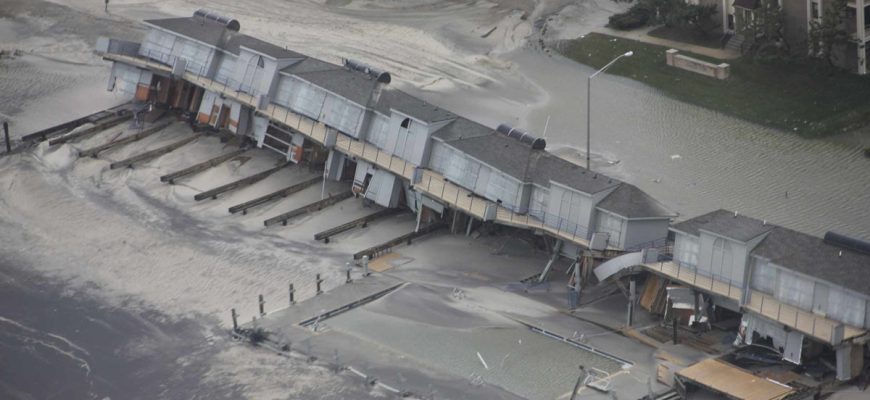
This home in Long Beach was under 6 ft of water at the height of the storm. The residents have been told it will be at least three months before that can move back in.
Light fixtures swung back and forth and the 59-story building creaked so loudly, Lindsay White and her sister Erin could barely hear themselves talk.
The sisters and roommates decided to ride out Hurricane Sandy since they were in Evacuation Zone B and nothing happened during last year’s Hurricane Irene.
“The water in the tub was going back and forth, it was creepy,” said Lindsay. “We hung out and tried not to think about it,” she said of the creaking.
The next day, White walked down 18 flights of stairs to survey the damage. Her building had been spared, but nearby blocks were not so lucky.
Swaths of mud, downed trees, broken windows and water-damaged buildings were widespread in the neighborhood. Dead rats floated down the gutters.
“There have been tons of clean-up crews on every block gutting out buildings and offices,” said White. “It’s crazy.”
Nearby, at 2 Gold Street, mechanical systems were so badly damaged, residents can’t live there until further notice, according to owner TF Cornerstone’s website.
Lindsay and Erin’s power went back on six days after Sandy and they were able to return home after staying with friends uptown.
But many others in New York, especially those along the coastline of Long Island and Staten Island, were not so lucky.
By Governor Cuomo’s estimate, between 20,000 and 40,000 New Yorkers have been forced to seek housing after Sandy ravaged their homes.
Dubbed “Frankenstorm” by meteorologists, Sandy did what officials are estimating to be $50 billion worth of damage to an area unlucky enough to be within the 1,000 mile-wide path of the monster hurricane.
FEMA announced Nov. 7 it would the amount of rental assistance money by 25 percent for Hurricane Sandy victims in need of housing. “It was quickly apparent that the cost of available rental units could become a limiting factor, so FEMA authorized funds to increase the existing rental assistance in New York and New Jersey to exceed current FY2013 levels by 125 percent,” said the agency in a press release.
But in a rental market already airtight, the outlook is grim for the New Yorkers left without housing after the storm.
Real Estate website StreetEasy.com posted a list of temporary housing in the five boroughs last week, around 150 short-term rentals, mostly apartments, with a median price of $3,600 and a median square footage of 891.
One rental, a 3,000 s/f, four bedroom, 4-bath in Chelsea listed for $20,000 a month, seemed more for a well-heeled refugee rather than the average Joe.
Airbnb, a website that allows users to rent out part or all of their homes, has partnered with the City of New York to help victims of the hurricane by offering space in their homes at no cost.

KATHY BRADDOCK
Kathy Braddock, co-founder of Rutenberg Realty, a residential real estate brokerage firm, said those forced to seek temporary housing need to make sure to look at their rental policy or homeowner policy to see what help insurance companies can give them.
“If they know that, they may be able to play with a different number than they had in mind,” she said. “If you’re a renter, you need to get in touch with your landlord ASAP; you don’t want to be stuck paying two rents.”
In addition to creating a Google group where people can post about available housing, agents are waiving their usual fees and each of Rutenberg’s 500 agents have donated at least $10 to Mayor Bloomberg’s relief fund.
Cooper Square Realty, the largest residential property management company in New York City, managing more than 70,000 residences that are home to 200,000 people, reported that properties it manages in the Far Rockaways were badly damaged during the storm.
“It’s definitely been the worst,” said Dana Collins, director of communications for Cooper Square. “Some of the contractors that helped us helped with Hurricane Katrina and they said it is the worst they’ve ever seen. People keep comparing it to a war zone.”
The company has brought food, water and supplies to the buildings still without power, and Cooper Square’s parent company, First Service Residential, established a $10 million fund in short-term loans for Sandy victims. Around 30 percent of First Service’s northeast portfolio was affected by the hurricane.

MARC SPECTOR
Marc Spector of Spector Group, an architecture and engineering firm, said Sandy was remarkable in the scope of its destruction.
“I haven’t seen damage like this since Hurricane Gloria in 1985,” said Spector. “The storm surge from this one was much worse. Such a broad, massive, diverse storm that’s caused such an array of damage.”
He suggested homeowners look to professionals before making any decisions about rebuilding. “Homeowners should not be assessing their own damage,” he said. “They should absolutely be talking to a professional who is knowledgeable. And don’t make assumptions because something ‘looks that way,’ it may not be that way.”
Mayor Bloomberg said more than $32 million has been raised to date by the Mayor’s Fund to Advance New York City for NYC’s emergency response needs and long-term restoration efforts from more than 10,000 donors from around the country. One hundred percent of all donations will go to support relief efforts and organizations.
Gary Malin, president of Citi Habitats, said despite the city’s tight housing market, housing can be found if those who need it take the right steps. “My advice to anyone who needs assistance is to find a compassionate professional, be it from a real estate firm or their insurance company, immediately — and ask about their options,” said Malin.
“It’s important to get on their radar screen. Remember, there are substantial resources in place to help those impacted by Hurricane Sandy. People want to help.”