 By Liana Grey
On a Friday afternoon eight years ago, Isaac Katan, founder of the Brooklyn-based firm, Global Developments, got a call from a friend with major news: the iconic Domino sugar refining plant near the Williamsburg Bridge had just shut down, and was about to be put up for sale.
“He told me I had 48-hours to tie up a deal before it went on the market,” Katan recalled.
Having developed both affordable housing and market-rate condos in Brooklyn for the past 25 years, Katan had long been aware of the one million square feet site’s potential to transform the Williamsburg waterfront into a luxury destination, with upscale shops, rental units, and a landscaped park.
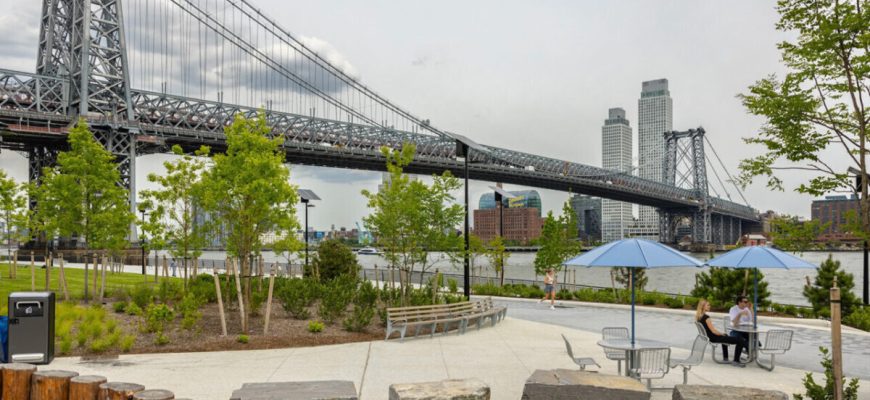
“It was a developer’s dream,” he said, pointing out stunning vistas of the Manhattan skyline and East River crossings from a waterfront park just north of the nearly 160-year-old factory.
After expressing interest in the site, Katan set out to form a joint venture. He had several potential partners in mind, but ultimately approached the Community Preservation Corporation, or CPC.
Katan had worked with the nonprofit lending agency regularly while building affordable housing, and knew the group had access to city and federal money.
The partners closed on the property in 2004, and drafted plans for a mixed-use behemoth stretching five blocks along Kent Avenue, beginning at South 5th Street at the base of the Williamsburg Bridge.
“Knowing CPC as a non-profit, I figured it would be all right,” Katan said. “I never thought I’d have issues with them.”
Fast forward eight years. Having spent $100 million preparing for construction, and facing financial trouble, the partners are embroiled in a dispute over control of financing and plans to bring in an outside investor.
After CPC defaulted on a $120 million loan for the project, its primary lender, the California-based fund Pacific Coast Capital Partners, was slated to take a larger stake in the development.
Though Pacific Coast Capital has a New York office, Katan insisted on bringing on board a local investor whom he believed would have a deeper understanding of Brooklyn’s evolving real estate market.
He was even rumored recently to have located a potential “White Knight” investor to save the project from foreclosure.
Katan declined to name anyone he’d spoken with, but made clear that he opposed handing over significant control to a firm headquartered on the West Coast.
“To give a California-based fund control is going to be a disaster,” he told Brokers Weekly.
Last month, after being barred from meeting with Pacific Coast Capital to negotiate terms or bring in an additional investor, Katan sued the CPC for breach of contract.
Susan Pollock, a senior vice president in CPC’s for-profit development wing, said this week that Katan never had control of financing sources to begin with.
“He has a consultation right,” she said, adding that CPC has consulted with him consistently over the years. “He’s chosen to go to court to exercise control he doesn’t have.”
At one point, Katan attempted to market his share of ownership, but each potential offer fizzled. “People would come and say, ‘We’ll give you x amount of money,’” said Pollock. “When we did due diligence, that wasn’t at all what they offered.”
Katan argues that the impasse reveals a fundamental difference in approach between primarily non-profit and profit-seeking developers.
CPC pledged that 30% of the project — or 660 out of 2,200 units — would be set aside for low-income families. Without a tight budget, Katan said, it would be difficult to make a profit. “To do this, you have to be 10 times more economical” than when developing market-rate developments, he explained.
Of course, a mega-project like the Domino site, which sprawls over 11 acres, hardly comes cheap: the total estimated cost is $1.2 billion.
As soon as the dispute between Katan and CPC is settled, the project will be built in six phases, beginning with 37,000 s/f of retail and 300 affordable housing units on an empty lot east of Kent Avenue.
Katan hopes to lease a portion of the retail space to a large supermarket, as well as restaurants and boutiques.
West of Kent Avenue, along the waterfront, much of the rundown, graffiti-covered factory will have to be demolished to make way for glass and steel towers with a wide range of unit sizes, from studios to four-bedroom penthouses.
A landmarked portion of the factory, including the iconic yellow sign visible from FDR Drive across the East River, will be preserved.
Katan isn’t sure yet whether the units will be condos or rental, but as of now he’s leaning towards the latter, which are in high demand across the neighborhood; last month, the brokerage firm MNS reported that studios in Williamsburg were the most expensive in the borough, renting for an average of $2,397 a month. The neighborhood also ranked third for priciest one- and two-bedroom rentals.
“The thing about Williamsburg is that it’s not just yuppies,” Katan explained. “It’s family-oriented, and there are retirees who want to live in a full-service building.”
Eventually, an esplanade will be constructed and will serve as a continuation of several nearby waterfront parks, including Brooklyn Bridge Park to the south and the open space surrounding Northside Piers, Toll Brothers’ boutique condo development, to the north.
“The city’s vision is to connect the Brooklyn Bridge to the Long Island City area,” said Katan. “After 150 years, people will have access to the waterfront.”
If the partners manage to reach an agreement quickly — the next court date is set for May 4 – Katan expects to begin construction on Phase One by the end of the year.
During the recession, Katan said that he sold over 250 units at projects elsewhere in Brooklyn, including condo developments in Greenpoint and Park Slope. So he’s especially frustrated by the slow pace of progress on the Domino site.
Since 2004, 80-year-old refining equipment has sat inside the factory, collecting dust. “We’ve already spent $100 million,” Katan said, “and we haven’t even moved equipment out.”