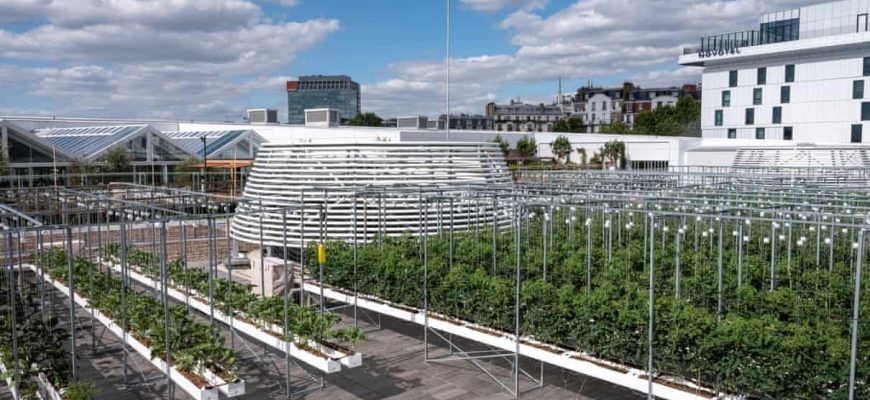
Edenworks is about as modern as a farm can get. In planters stacked to the ceiling of a sunlit, 800-s/f greenhouse, the startup is growing bok choi, arugula, turnips, sage and lettuce. The plants are fertilized with waste water from fish tanks, where Edenworks is raising Tilapia. In the process of fertilization, the water is filtered and ultimately returns to the tanks, beginning the cycle anew. But perhaps the most impressive aspect of this complex procedure – called aquaponic farming – is that it all takes place on the rooftop of a small commercial building in Bushwick.

Zadok Zvi, the landlord, and Ben Silverman at Edenworks’ greenhouse in Bushwick
For now, Edenworks is not paying any rent. The building belongs to the father in law of Jason Green, one of the firm’s co-founders along with Ben Silverman and Matt la Rosa. But the firm is searching for a roof to accommodate a new, 10,000-s/f greenhouse. Silverman told Real Estate Weekly that he hopes to sign a lease for around $5 per s/f. This may be a tiny sum in commercial real estate, but it is still significantly more than the $0 most rooftops in the outer boroughs are currently generating for their owners.
In five years, Edenworks hopes to run several farms in New York City. In its ambition, the plan is a bet that rooftop farming is finally ready for take-off.
Rooftop farming has been touted as the next big thing for years, but the reality was more sobering. In mid-2012, the New York Times declared that New York is “suddenly a farming kind of town”. Around the same time, the city’s Economic Development Corporation issued a request for proposals to create a 200,000 s/f rooftop farm – the largest in the U.S. – on a warehouse in the South Bronx. In Brooklyn, BrightFarms announced it would launch a 100,000-s/f greenhouse on the roof of a former Navy warehouse in Sunset Park.
But in the following two years, much of the initial excitement over the potential of rooftop farming dissolved into thin air. The EDC has since pulled its plans for a rooftop farm. “After discussions with the respondents, we determined that the projects were not feasible, so there are no plans to develop a rooftop farm on that site,” an EDC spokesperson told Real Estate Weekly. BrightFarms has also shelved its plans for a rooftop greenhouse. “We are still looking for locations in NYC, but not focused on rooftops given the cost, complexity and time required to build a rooftop greenhouse at the scale we would require,” BrightFarms’ director of business development, Toby Tiktinsky, said.
 As it turns out, building and maintaining a giant rooftop greenhouse in New York City is expensive. And with world food prices falling by 20 percent since 2011, according to the UN, profitability has only become more of an issue. To be sure, there are several rooftop farms in New York City. For example, Brooklyn Grange operates a 65,000-s/f rooftop farm in the Brooklyn Navy Yard and Gotham Greens fields a greenhouse atop a warehouse in Greenpoint. But the hoped-for boom in rooftop farming has yet to materialize.
Silverman believes it will, and he is banking on new trends in the commercial real estate market. As bleak office buildings are becoming a thing of the past, more and more landlords are trying to pack their buildings with amenities in order to make them more attractive to tenants. The trend, spearheaded by firms like Google, is to turn office buildings into places where worker enjoy spending time, and where they can meet as many of their needs as possible.
Silverman, a trained architect who co-founded the Edenworks in early 2014, said he is currently in talks with an office landlord in Long Island City. His pitch (other than the $5 rent) is that being able to buy vegetables on the roof of your building would be a nice amenity for office tenants. Ideally, Edenworks wants to sell its produce exclusively to tenants in its own building and deliver the fish to restaurants.
Edenworks also hopes the modular design of its greenhouse will keep installation costs low. Rather than build a small building on a rooftop, Silverman argues, the costs would be more similar to installing solar panels or an HVAC system.
Silverman acknowledged that negotiations aren’t easy. While Edenworks is willing to pay for the construction of the greenhouse, it needs tenant improvements, such as electricity and gas boilers. But despite the challenges, the potential benefits to both sides are significant. As the competition for office tenants in New York City intensifies, a rooftop farm could give a landlord a much-needed edge in the hunt for creative firms. And in the process, New York might become that farming kind of town after all.